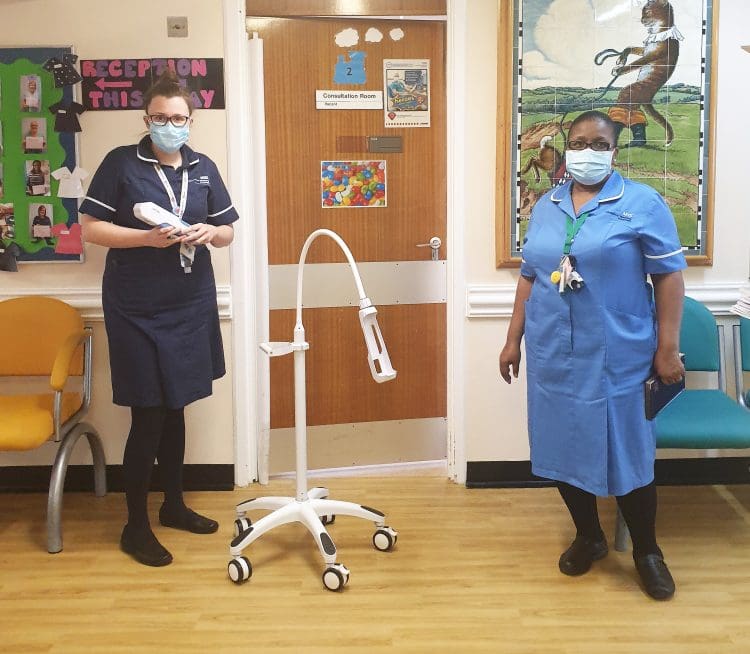
A range of medical equipment is needed at Tameside General Hospital to improve care in the neo natal and children’s units.
Children’s unit: Airvo oxygen delivery machine
When children have respiratory distress – severe chest infection, asthma or bronchiolitis – they often require supplementary oxygen. The Airvo 2 Optiflow System features a humidifier which comfortably delivers high flows of air/oxygen mixtures, but is less intensive than other respiratory support systems. The Airvo 2 machine will help provide additional care to patients who require non-invasive ventilation. It will be particularly useful during the winter season.
Children’s unit: Blood pressure monitors
When children are admitted to hospital, a set of observations is carried out by a member of staff on each patient, and repeated regularly throughout their stay to pick up any underlying problems. These monitors help staff to quickly and accurately assess vital signs with minimal intrusion. The children’s unit currently has two machines shared between 12 clinic rooms. Having more of these machines will help to improve the flow of patients through the department.
Children’s unit: Baby weighing scales
Every baby that comes through the children’s unit needs to be weighed, and scales are of paramount importance for medication reviews and treatments carried out by weight. The current baby scales in the unit are well used and near the end of their working life. The last service review indicated that a new set would be required.
Neo natal unit: Apnoea monitors
Apnoea monitors are used when a baby is asleep. They alert the medical team to any changes in a baby’s breathing, so they can intervene. They allow a swift response to avoid oxygen deprivation. Ward Manager Donna Kennedy-Marriott says: “Respiration monitors for apnoea detection are used for babies in the neo natal unit to progress from intensive/high dependency care to special care. This gives the parents reassurance that their baby is doing well and is moving towards discharge home without any monitoring.”
Community team: Pulse oximeters
The Tameside and Glossop Children’s Community Team supports the neo natal unit by enabling babies to be discharged home on oxygen where required and reducing acute hospital admissions by giving support and advice to families at home. A handheld oxygen saturation monitor (pulse oximeter) is needed for each baby. Manager Jessica Oakes says: “These babies remain under the care of a consultant with a clear weaning plan for their oxygen. We have had an increased number of babies discharged with oxygen, highlighting the need for more monitors in order to manage them safely at home.”